Why Getting Outside Makes Parenting Easier

A Little Nature for a Happier Mama and Calmer Kids
Did you know that research shows that too much time spent indoors in artificial environments can lead to exhaustion and reduced vitality? Nature makes it easier to feel happy, calm yet awake, and attentive. It also helps to loosen the grip of challenging emotions like anger and anxiety.¹ Yes, there are plenty of studies telling us that we need to get outside more. Staying indoors will not do you any favours if you want to be the best version of yourself.²
For mothers navigating the demands of parenting, especially during postpartum recovery, spending time outside can support maternal wellbeing and help ease feelings of overwhelm or postpartum fatigue.
Have you ever noticed your baby’s mood shifts when they go outside? A trick I used to use and still do…
The Benefits of Sunshine for Moms and Postpartum Health
Exposure to daylight is something that us humans have been designed to crave, for good reason.
Sunshine is essential for our bodies and brains to work optimally. Sunlight supports vitamin D production and BDNF, helps maintain a healthy gut microbiome, strengthens the immune system, decreases anxiety, and supports melatonin and serotonin production. It also improves mood and memory, lifts your energy during the day, helps you sleep more restfully at night and helps regulate your circadian rhythms.³
Not only do we benefit from exposure to daylight, but we actually require it for our bodies to work optimally and stave off mental and physical health issues.⁴
Grounding in Nature for Maternal Wellbeing
Put your feet on the earth.
Connecting with the earth speeds up the body’s healing process. It reduces jet lag, speeds up recovery from workouts and helps the body deal with the influx of electromagnetic frequencies (EMF) emitted from devices, electronics, appliances and wifi. It also improves sleep, reduces pain and improves overall well-being.⁵
Dr. Nicole Nelson emphasizes the importance of including time in nature and grounding specifically in her patients’ treatment plans. Similarly, Dr. Janet Kim strongly advocates for the immense benefit of grounding for our health and hormones. She too recommends this to her patients.⁶ Nature brings a restorative balance into play.
When I hear of doctors prescribing time in nature and grounding in their treatment plans for patients, it makes my day. No it certainly doesn’t cure all illnesses. But it is an often overlooked, yet simple way to get the body back into balance and reduce stress. Both of these, depleted mamas could do well with.
On one such day, as I attended the foundational training with ACNEM, it gave me so much hope for the future of medicine.
Isn’t it nice when science and your lived experiences coincide?
While nothing feels better than putting your feet on the grass or walking in the ocean waves, sometimes it isn’t realistic to get so intimate with nature. I’m thinking of those frigid days I experienced too many times for my liking in Canadian winters.
There are endless benefits to this direct physical connection to the earth. It reduces inflammation in the body, chronic pain, headaches, fatigue and muscle tension while increasing blood flow and energy. Grounding increases feelings of calm, peace and connection with the greater world around you. It also reduces stress, improves immunity and helps stabilize cortisol.⁷Going barefoot has also been found to improve sleep by making it easier to fall asleep, wake less often and even reduce sleep apnea.⁸ Reduced pain and relief from asthma, rheumatoid arthritis and PMS have also been observed after grounding.⁹
Looking at Nature Can Reduce Stress for Moms
Nature is restorative, even just looking at it from a window. So, if you can’t get outside, a view of nature can improve your health.
Seeing nature even from a window improves well-being, relieves stress and brings you back to calm after watching a horror flick more quickly than urban scenes.¹⁰ It makes it easier for us to switch on our calming parasympathetic nervous system. That is something that we could all use a lot more of.
Imagine what it might do for you to look out your window more often.
The amount of work that comes with getting a pet might push a tired mama to exhaustion. I get it! My eldest son has been asking for a puppy since he could talk. We will get him one eventually in a couple of years; the plan is for his nana to surprise him with one for his fifth birthday.
I wonder if you can pick the chapters in this book that I wrote outside versus those I did not. Although there are other factors to consider, like how many times my kids woke me in the night or are my kids climbing on me while I write this. But hopefully, the effect of writing while looking at these lovely birds and trees is helping.
I am going to be presumptuous and say it would likely do the same for the job of mothering too. Although quitting isn’t really an option for us, is it?
Viewing nature while driving through nature is also associated with less stress and greater resilience in the face of other stressors.¹¹ So next time you put your baby in the car in hopes they finally nap, consider where you might go on the drive. If her view from the car seat is of trees and rivers, she might just calm down a little faster and if she does cry, you’ll be better able to cope with it than if you are driving down a multilane highway.
Even just viewing pictures of nature improves our mood.¹² Ever noticed how a beach house makes you feel happy with its accents of shells, recovered wood and ocean photos? Consider what pieces of nature you can bring into your home. What natural materials you could use in your furniture? Think about what images you would like on your walls or on your computer background. I wonder if watching David Attenborough films and other nature documentaries have the same effect.
Integrate more nature into your day-to-day life, your home and time with your children.
If you weren’t aware before, after reading this chapter, you know that this isn’t just fluff. There is real hard science backing up the benefits of more connection with nature. We are doing a disservice to ourselves and our kids if we keep the windows closed, shoes on and spend all of our time indoors.
For more ideas on small ways to improve your wellbeing as a mom, you might enjoy this article on micro-shifts and small choices that create a vibrant life.
And if you’ve ever felt the pressure to constantly put everyone else first, this piece on why being selfless in motherhood isn’t always a good thing may also resonate.
So go out there. Enjoy a little sunshine. Breathe in the fresh air of a forest. Get your feet in contact with the earth. At least, open your windows and put up a nice ocean view as your phone’s background. But imagine if you were to jump in the puddles, play in the mud or run through a sprinkler in your bare feet? Your kids will think you are the best thing since sliced bread if you do so. I’ll bet you might just feel a whole lot more energetic than you did before. Who says kids get to have all the fun?
If you’d like more gentle guidance on nourishing yourself while raising little ones, you may enjoy my book Nourished Mama. And for conversations about motherhood, health, and raising thriving kids, you can also listen to the Wild and Well podcast.
References:
¹
Rohde, C. L. E., & Kendle, A. D. (1994). Human Well-being, Natural Landscapes and Wildlife in Urban Areas: A Review. Report to English Nature. Department of Horticulture and Landscape and the Research Institute for the Care of the Elderly, University of Reading, Bath.
Maller, C., Townsend, M., Pryor, A., Brown, P., & St Leger, L. (2006). Healthy nature healthy people: “Contact with nature” as an upstream health promotion intervention for populations. Health Promotion International, 21(1), 45–54. https://doi.org/10.1093/heapro/dai032
²
Aranow, C. (2011). Vitamin D and the immune system. Journal of Investigative Medicine: The Official Publication of the American Federation for Clinical Research, 59(6), 881–886. https://doi.org/10.2310/JIM.0b013e31821b8755
Rohde, C. L. E., & Kendle, A. D. (1994). Human Well-being, Natural Landscapes and Wildlife in Urban Areas: A Review. Department of Horticulture and Landscape and the Research Institute for the Care of the Elderly, University of Reading, Bath.
³
Aranow, C. (2011). Vitamin D and the immune system. Journal of Investigative Medicine, 59(6), 881–886. https://doi.org/10.2310/JIM.0b013e31821b8755
Kim, J. (2020). Women’s Health and Hormones. [Conference Session]. Foundations of Nutritional and Environmental Medicine, Australasian College of Nutritional and Environmental Medicine Part 2. https://online.acnem.org/
Brosnan, J. L. (2019). Rhythm Reset. Self-published ebook.
Masson, L. (2020). Children’s Health. [Conference Session]. Foundations of Nutritional and Environmental Medicine, Australasian College of Nutritional and Environmental Medicine Part II. https://online.acnem.org/
Lin, S. Vitamin D through sun: 9 tips to optimize your levels. Dr. Steven Lin – The Functional Dentist. Retrieved June 23, 2020, from https://www.drstevenlin.com/optimize-vitamin-d-through-sun/
Read, J. (2020). Cardiometabolic Fundamentals. [Conference Session]. Foundations of Nutritional and Environmental Medicine, Australasian College of Nutritional and Environmental Medicine Part 1. https://online.acnem.org/
Gajjar, A. (2020). Lifestyle Medicine. [Conference Session]. Foundations of Nutritional and Environmental Medicine, Australasian College of Nutritional and Environmental Medicine Part II. https://online.acnem.org/
Weaver, L. (2017). Rushing Woman’s Syndrome. Dr Libby Online.
⁴
VELUX. The Indoor Generation: Facts and Figures. Retrieved January 12, 2021, from
https://www.velux.com/indoorgeneration/indoor-generation-facts-and-figures
⁵
Chevalier, G., Sinatra, S. T., Oschman, J. L., Sokal, K., & Sokal, P. (2012). Earthing: Health implications of reconnecting the human body to the Earth’s surface electrons. Journal of Environmental and Public Health. https://doi.org/10.1155/2012/291541
Ober, C. (2000). Grounding the human body to neutralize bioelectrical stress from static electricity and EMFs. ESD Journal.
Oschman, J. L. (2008). Perspective: Assume a spherical cow: The role of free or mobile electrons in bodywork, energetic and movement therapies. Journal of Bodywork and Movement Therapies, 12(1), 40–57.
Oschman, J. L. (2009). Charge transfer in the living matrix. Journal of Bodywork and Movement Therapies, 13(3), 215–228.
Ghaly, M., & Teplitz, D. (2004). The biologic effects of grounding the human body during sleep as measured by cortisol levels and subjective reporting of sleep, pain, and stress. Journal of Alternative and Complementary Medicine, 10(5), 767–776.
⁶
Kim, J. (2020). Women’s Health and Hormones. [Conference Session]. Foundations of Nutritional and Environmental Medicine, Australasian College of Nutritional and Environmental Medicine Part 2. https://online.acnem.org/
Nelson, N. (2020). Mental Health; Biochemical Pathways. [Conference Session]. Foundations of Nutritional and Environmental Medicine, Australasian College of Nutritional and Environmental Medicine Part 1. https://online.acnem.org/
⁷
Ober, C. (2000). Grounding the human body to neutralize bioelectrical stress from static electricity and EMFs. ESD Journal.
Oschman, J. L. (2008). Perspective: Assume a spherical cow: The role of free or mobile electrons in bodywork, energetic and movement therapies. Journal of Bodywork and Movement Therapies, 12(1), 40–57.
Oschman, J. L. (2009). Charge transfer in the living matrix. Journal of Bodywork and Movement Therapies, 13(3), 215–228.
⁸
Ghaly, M., & Teplitz, D. (2004). The biologic effects of grounding the human body during sleep as measured by cortisol levels and subjective reporting of sleep, pain, and stress. Journal of Alternative and Complementary Medicine, 10(5), 767–776.
Ober, C. (2000). Grounding the human body to neutralize bioelectrical stress from static electricity and EMFs. ESD Journal.
Oschman, J. L. (2008). Perspective: Assume a spherical cow: The role of free or mobile electrons in bodywork, energetic and movement therapies. Journal of Bodywork and Movement Therapies, 12(1), 40–57.
⁹
Ober, C. (2000). Grounding the human body to neutralize bioelectrical stress from static electricity and EMFs. ESD Journal.
Oschman, J. L. (2008). Perspective: Assume a spherical cow: The role of free or mobile electrons in bodywork, energetic and movement therapies. Journal of Bodywork and Movement Therapies, 12(1), 40–57.
¹⁰
Kaplan, S. (1992). The restorative environment: Nature and human experience. In Relf, D. (Ed.), Role of Horticulture in Human Well-being and Social Development: A National Symposium (pp. 134–142). Timber Press.
Lewis, C. A. (1996). Green Nature/Human Nature: The Meaning of Plants in Our Lives. University of Illinois Press.
Leather, P., Pyrgas, M., Beale, D., & Lawrence, C. (1998). Windows in the workplace. Environment and Behavior, 30, 739–763.
Maller, C., Townsend, M., Pryor, A., Brown, P., & St Leger, L. (2006). Healthy nature healthy people. Health Promotion International, 21(1), 45–54. https://doi.org/10.1093/heapro/dai032
Ulrich, R. S., Dimberg, U., & Driver, B. L. (1991). Psychophysiological indicators of leisure benefits. In Driver, B. L., Brown, L. R., & Peterson, G. L. (Eds.), Benefits of Leisure (pp. 73–89). Venture Publishing.
Ulrich, R. S., Simons, R. F., Losito, B. D., Fiorito, E., Miles, M. A., & Zelson, M. (1991). Stress recovery during exposure to natural and urban environments. Journal of Environmental Psychology, 11, 231–248.
¹¹
Parsons, R., Tassinary, L. G., Ulrich, R. S., Hebl, M. R., & Grossman-Alexander, M. (1998). The view from the road: Implications for stress recovery and immunization. Journal of Environmental Psychology, 18, 113–140.
¹²
Rohde, C. L. E., & Kendle, A. D. (1994). Human Well-being, Natural Landscapes and Wildlife in Urban Areas: A Review. Department of Horticulture and Landscape and the Research Institute for the Care of the Elderly, University of Reading, Bath.
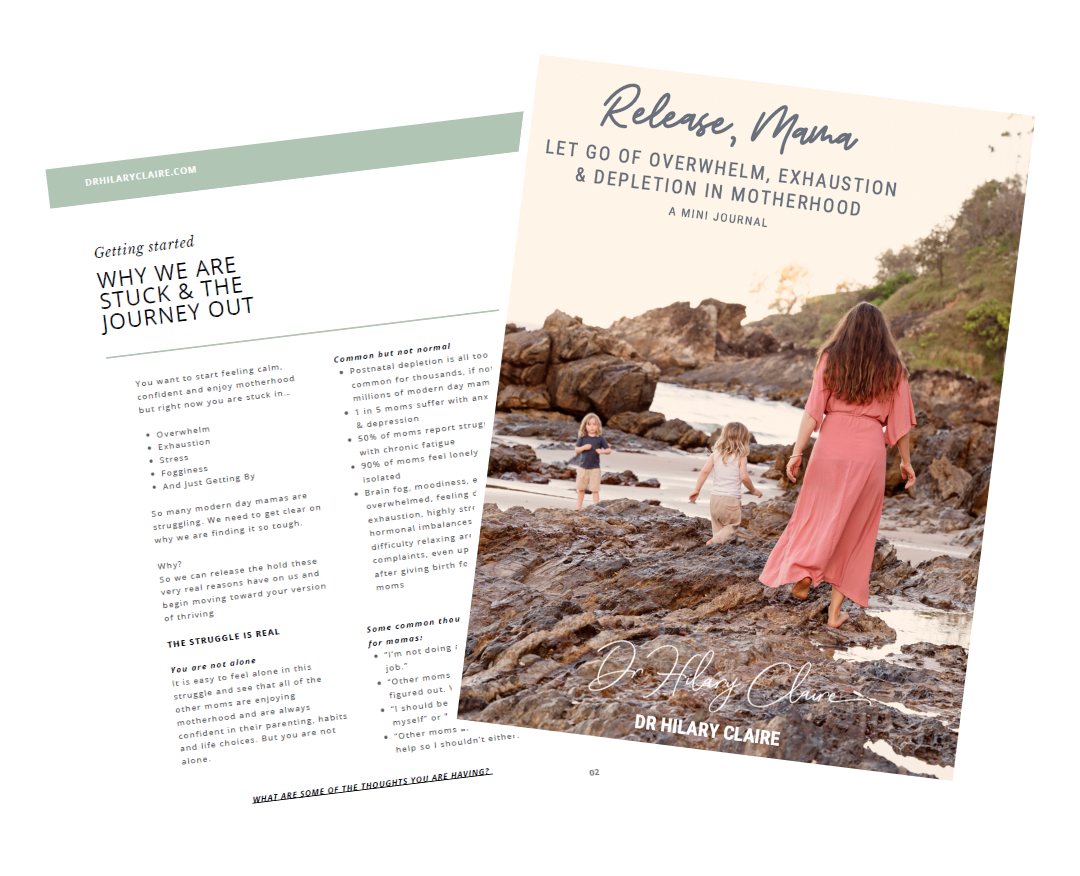
Release, Mama Mini-Journal
In this mini journal, you will identify your unique reasons for struggling with exhaustion, overwhelm, guilt or burnout. Then you will be guided in letting these go and taking effective action to create a future that makes it easier for you to thrive.
Start living motherhood on your own terms.

50% Complete
Keep Up-To-Date
For a regular dose of useful resources and articles from Dr Hilary Claire delivered straight to your inbox pop your details below.