Simple Food Swaps to Boost Energy for Busy Moms

Food Nasties & Simple Swaps for More Energy
Have you ever had one of those days where everything seems to be going wrong? Perhaps the kids are fussy, there’s a work emergency, you didn’t sleep well and the dog chewed the couch.
When I used to run up against days like this, I would think to myself, “Oh, I deserve a treat to make myself feel better.” So I’d reach for some chocolate, be satisfied for a brief moment but then ultimately feel worse. The sugar “high” soon had me crash and feel even more exhausted.
Have you experienced this too?
Food and mental health are closely linked. What you eat has a massive effect on your mood, health and vitality. As a busy mom, you need your food to help you feel vibrant and energetic rather than pulling you down, something that becomes especially important during postpartum recovery when many women experience fatigue and postnatal depletion.
After finding myself in my own struggle with postnatal depletion, food was one of the first things I focused on to pull myself out. It can move us toward a future full of vitality, happiness and health, or push us into even greater exhaustion.
I began by ensuring my fridge and pantry didn’t contain foods that would put further strain on my energy, mood and overall health.
Inflammation is one big factor that connects what you eat to your energy, mood and brain health. An inflamed body is lethargic. An inflamed brain is foggy and low in mood.
I want my body free from the sluggishness that comes with chronic inflammation. I want my brain free from the fogginess that comes with it too. And I intend to raise my kids with foods that support sharp, happy minds and resilient bodies.
The good news?
You have the power to change these things simply by changing what lives in your kitchen cupboards.
Artificial Additives
Artificial additives often come with bright marketing and long shelf lives, but they rarely support lasting health or vitality.
Calling many of these ultra-processed products “food” can be a stretch.
As a mom balancing the demands of parenting and life, if avoiding additives helps me maintain more nutrient reserves and supports calmer, healthier kids, I’m in.
My goal here isn’t perfection. It’s simply helping you make more informed choices about what you eat and feed your family.
Added Sugar and Energy Crashes
Sugar goes by many names.
Naturally occurring sugar in fruit has been part of human diets for millennia. But the amount of added sugar consumed in modern society is staggering. According to the National Cancer Institute, the average person consumes around 24 teaspoons of added sugar per day.
For busy moms, especially those navigating postpartum fatigue or mom burnout, frequent energy crashes make everyday life much harder.
If a food repeatedly leaves you feeling exhausted, foggy and low in mood, it simply isn’t supporting the vibrant version of yourself.
Industrial Vegetable Oils
For decades, animal fats were demonized while refined “vegetable” oils were promoted as healthier alternatives.
Despite their name, these oils are not made from vegetables but from highly processed seeds such as soybean, corn, safflower, sunflower and canola.
Industrial seed oils increase omega-6 fatty acids in the diet dramatically, contributing to inflammation when consumed in excess. They are also unstable and easily oxidized when exposed to heat and light, producing harmful compounds.
Humans didn’t consume these oils until the early 1900s when they were first developed. Our bodies simply were not designed to consume them in such large quantities.
When deep-fried foods are repeatedly cooked in these oils, as often happens in restaurants, even more harmful by-products are produced.
My aging has accelerated enough raising two wild boys. I don’t need help speeding it up further.
Focus on Real Food Instead
We are all individuals with unique genetics, preferences and circumstances, so one diet does not fit everyone.
However, one principle holds true for almost everyone: eating real, minimally processed food supports energy, mood and overall health.
Replace ultra-processed foods with whole foods like:
- vegetables and fruit
- quality fats
- whole grains
- responsibly raised animal products or plant alternatives
The goal isn’t perfection. It’s nourishment.
If you’d like a deeper guide to restoring your energy through nutrition, I share more practical strategies in my book Nourished Mama.
3 Simple Food Shifts to Start With
If this still feels overwhelming, that’s okay.
The best foods to restore energy as a mom are often simply the opposite of the “nasties.” Focus on fresh, whole foods that are as close to their natural form as possible.
Here are a few small shifts to begin:
- Familiarize yourself with the ingredients in packaged foods you buy
- Swap one packaged snack for a whole-food option like fruit, nuts or vegetables and hummus
- Choose one or two organic fruits or vegetables instead of conventional ones
- Make a triple batch of muffins, cookies or granola bars and freeze them instead of buying processed snacks
- Replace vegetable oils in baking with ghee, coconut oil or cold-pressed oils
- Choose plain Greek yogurt and add berries instead of buying flavoured versions
Focus on real food and you won’t miss the nasties.
Over time, many moms notice improved energy, clearer thinking and calmer behaviour in their children as well.
For more conversations about nourishing yourself and raising thriving kids, you can also listen to the Wild and Well podcast.
References
DiNicolantonio, J. J., & O’Keefe, J. H. (2015). Omega-6 vegetable oils as a driver of coronary heart disease: The oxidized linoleic acid hypothesis. Open Heart, 5. https://doi.org/10.1136/openhrt-2018-000898
Esmaillzadeh, A., & Azadbakht, L. (2008). Home use of vegetable oils, markers of systemic inflammation, and endothelial dysfunction among women. American Journal of Clinical Nutrition, 88(4), 913–921. https://doi.org/10.1093/ajcn/88.4.913
Fallon, S., & Enig, M. (1999). Nourishing Traditions: The Cookbook that Challenges Politically Correct Nutrition and the Diet Dictocrats(2nd ed.). Washington, DC: New Trends Publishing.
Fernandes, G. (1994). Dietary lipids and risk of autoimmune disease. Clinical Immunology and Immunopathology, 72(2), 193–197. https://doi.org/10.1006/clin.1994.1129
Golomb, B. A., & Bui, A. K. (2015). A fat to forget: Trans fat consumption and memory. PLoS ONE, 10(6). https://doi.org/10.1371/journal.pone.0128129
Golomb, B. A., Evans, M. A., White, H. L., & Dimsdale, J. E. (2012). Trans fat consumption and aggression. PLoS ONE, 7(3). https://doi.org/10.1371/journal.pone.0032175
Harvard Health Publishing. (2019). The sweet danger of sugar. Harvard Medical School. Retrieved April 1, 2021, from
https://www.health.harvard.edu/heart-health/the-sweet-danger-of-sugar
Jaarin, K., Mustafa, M. R., & Leong, X. F. (2011). The effects of heated vegetable oils on blood pressure in rats. Clinics (Sao Paulo, Brazil), 66(12), 2125–2132. https://doi.org/10.1590/s1807-59322011001200020
Kresser, C. (2019, February 19). How industrial seed oils are making us sick. Retrieved February 9, 2020, from
https://chriskresser.com/how-industrial-seed-oils-are-making-us-sick
Lauretti, E., & Praticò, D. (2017). Effect of canola oil consumption on memory, synapse and neuropathology in the triple transgenic mouse model of Alzheimer’s disease. Scientific Reports, 7. https://doi.org/10.1038/s41598-017-17373-3
Loef, M., & Walach, H. (2013). The Omega-6/Omega-3 ratio and dementia or cognitive decline: A systematic review on human studies and biological evidence. Journal of Nutrition in Gerontology and Geriatrics, 32(1), 1–23. https://doi.org/10.1080/21551197.2012.752335
Lowe, S. (2014, January). Rice bran oil: The scoop. Retrieved February 7, 2020, from
https://thenaturalnutritionist.com.au/rice-bran-oil-the-scoop/
Lugavere, M., & Grewal, P. (2018). Genius Foods: Become Smarter, Happier, and More Productive While Protecting Your Brain for Life.Harper Wave.
Mattews, S. (2018, December 29). Cardiologist slams ‘incorrect’ advice from the World Health Organization urging people to replace butter and lard with vegetable oils. Daily Mail Australia.
https://www.dailymail.co.uk/health/article-6535725/Cardiologist-slams-incorrect-diet-advice-World-Health-Organization.html
Ng, C. Y., Leong, X. F., Masbah, N., Adam, S. K., Kamisah, Y., & Jaarin, K. (2014). Heated vegetable oils and cardiovascular disease risk factors. Vascular Pharmacology, 61(1), 1–9. https://doi.org/10.1016/j.vph.2014.02.004
O’Meara, C. (2014, February). Rice bran oil: Is it really all that good? Retrieved February 9, 2020, from
https://changinghabits.com.au/blog/2014/02/04/rice-bran-oil-is-it-really-all-that-good/
Perumalla Venkata, R., & Subramanyam, R. (2016). Evaluation of the deleterious health effects of consumption of repeatedly heated vegetable oil. Toxicology Reports, 3, 636–643. https://doi.org/10.1016/j.toxrep.2016.08.003
Rockwell, C., Gangur, V., Pestka, J., Para, R., Turley, A., Zagorski, J., Bursley, J., & Dover, H. (2014). The Nrf2 activator, tBHQ, exacerbates immediate hypersensitivity response to food allergen. The Journal of Immunology, 192(1), 119–130.
Safarinejad, M. R., Hosseini, S. Y., Dadkhah, F., & Asgari, M. A. (2010). Relationship of omega-3 and omega-6 fatty acids with semen characteristics and antioxidant status of seminal plasma. Clinical Nutrition, 29(1), 100–105. https://doi.org/10.1016/j.clnu.2009.07.008
Shanahan, C., & Shanahan, L. (2017). Deep Nutrition: Why Your Genes Need Traditional Food. Flatiron Books.
Turley, A. E., Zagorski, J. W., & Rockwell, C. E. (2015). The Nrf2 activator tBHQ inhibits T cell activation of primary human CD4 T cells. Cytokine, 71(2), 289–295. https://doi.org/10.1016/j.cyto.2014.11.006
U.S. Department of Health and Human Services: National Toxicology Program. (2016). Report on Carcinogens (14th ed.).
https://ntp.niehs.nih.gov/ntp/roc/content/profiles/butylatedhydroxyanisole.pdf
Wathes, D. C., Cheng, Z., Marei, W., & Fouladi-Nashta, A. (2013). Polyunsaturated fatty acids and fertility in female mammals: An update. CAB Reviews Perspectives in Agriculture, Veterinary Science, Nutrition and Natural Resources, 8, 1–14. https://doi.org/10.1070/pacsnnr20138041
Wells, K. (2018, December). Why you should never eat vegetable oils or margarine. Retrieved February 5, 2020, from
https://wellnessmama.com/2193/never-eat-vegetable-oil/
Wendell, S. G., Baffi, C., & Holguin, F. (2014). Fatty acids, inflammation, and asthma. The Journal of Allergy and Clinical Immunology, 133(5), 1255–1264. https://doi.org/10.1016/j.jaci.2013.12.1087
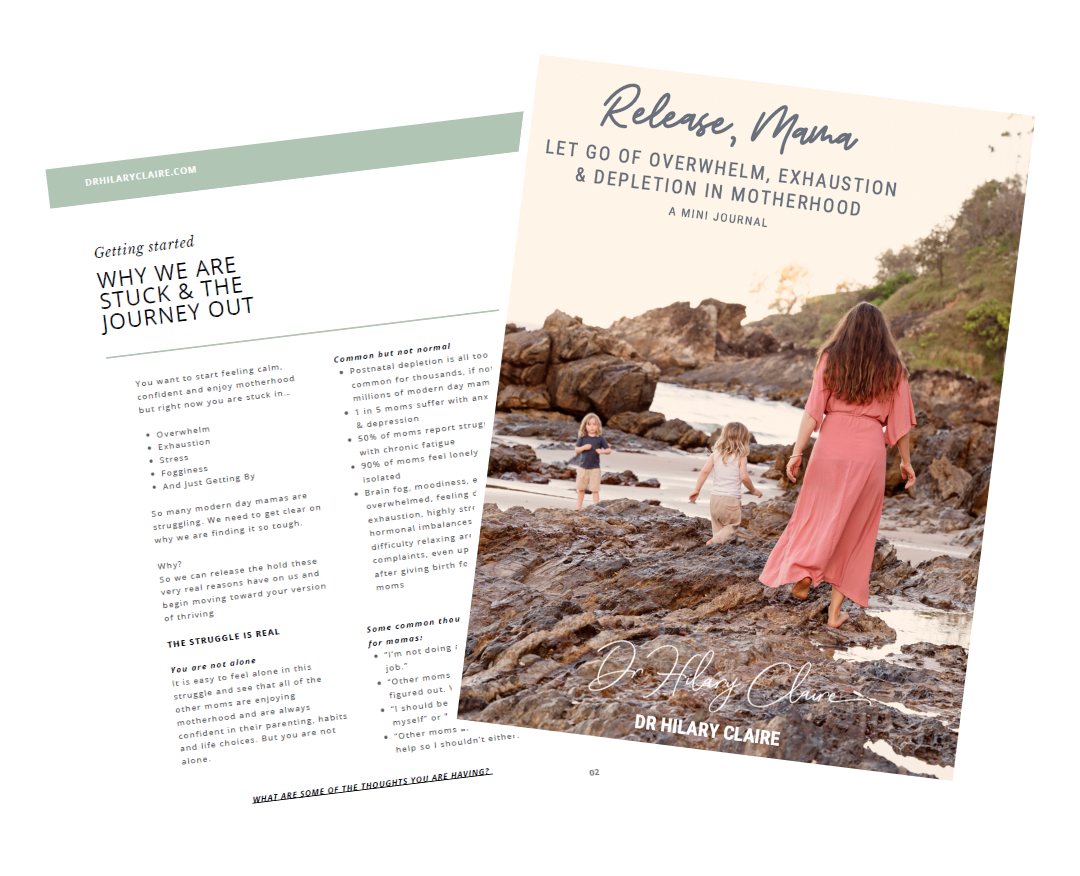
Release, Mama Mini-Journal
In this mini journal, you will identify your unique reasons for struggling with exhaustion, overwhelm, guilt or burnout. Then you will be guided in letting these go and taking effective action to create a future that makes it easier for you to thrive.
Start living motherhood on your own terms.

50% Complete
Keep Up-To-Date
For a regular dose of useful resources and articles from Dr Hilary Claire delivered straight to your inbox pop your details below.